Every modern app—from your favorite mobile game to online banking—needs a reliable place to store and retrieve data. When software engineers design a backend, the very first database decision they face is: Should we use SQL or NoSQL?
To understand the difference, imagine two completely different ways to organize your bedroom:
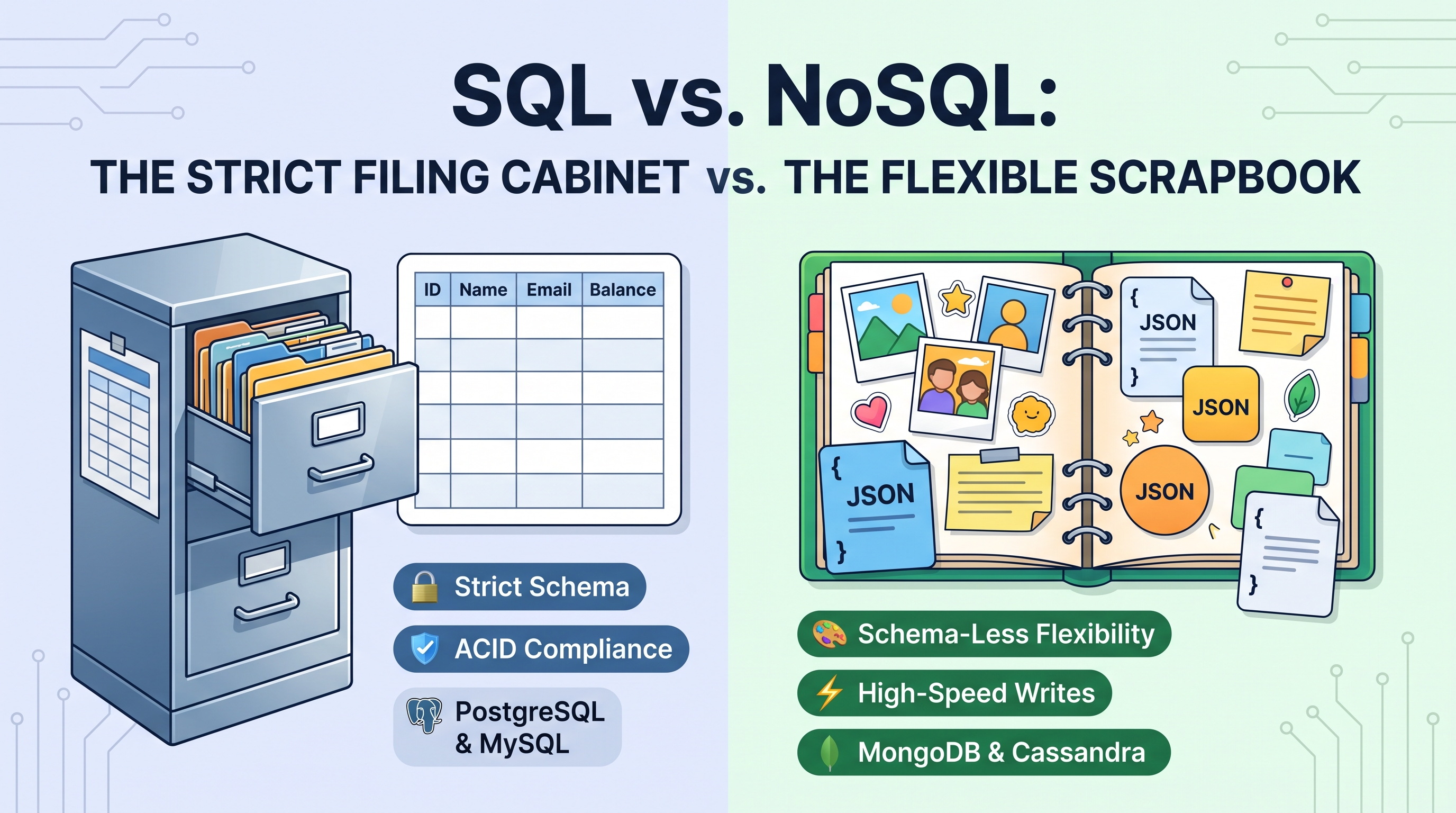
- The Strict Filing Cabinet (SQL): Every single folder is labeled with a rigid template. Every paper inside must be printed on standard A4 sheets with exact borders and columns. If you try to slip in an odd-sized photograph or an unformatted sticker, the filing drawer refuses to close!
- The Flexible Scrapbook (NoSQL): You have a big colorful scrapbook. On page one, you paste a photo; on page two, you write a handwritten note; on page three, you stick a movie ticket. Every single page can have its own unique layout without asking anyone for permission!
Keywords
- SQL (Relational Database): Data organized into structured, predefined tables with rows and columns (e.g., PostgreSQL, MySQL, SQLite).
- NoSQL (Non-Relational Database): Data stored in flexible formats such as JSON documents, key-value stores, or wide columns without rigid tabular rules (e.g., MongoDB, Apache Cassandra, Redis).
- Schema: The strict blueprint and rules defining what data types and columns a database table is allowed to store.
- ACID Compliance: A set of four strict guarantees (Atomicity, Consistency, Isolation, Durability) ensuring database transactions are processed 100% reliably without corruption or partial writes.
- Vertical Scaling (Scale-Up): Making a single database server more powerful by adding a faster CPU, more RAM, and larger SSDs.
- Horizontal Scaling (Scale-Out): Spreading database load across a distributed cluster of multiple smaller, interconnected servers.
- Polyglot Persistence: The modern practice of using both SQL and NoSQL databases together within the same application, giving each service the tool best suited for its workload.
Character Mapping
- SQL (PostgreSQL / MySQL): The Strict Office Filing Cabinet with rigid labeled folders.
- NoSQL (MongoDB / Cassandra): The Creative Scrapbook where every page has its own custom shape.
- Primary / Foreign Keys: The Paperclips and Color-coded Ribbons linking related folders together.
- Database Schema: The Standardized Company Form that everyone must fill out identically.
- ACID Transactions: The Bank Vault Security Guard ensuring money never leaves one pocket without landing safely in another.
1. SQL: The Strict Filing Cabinet (Relational Databases)
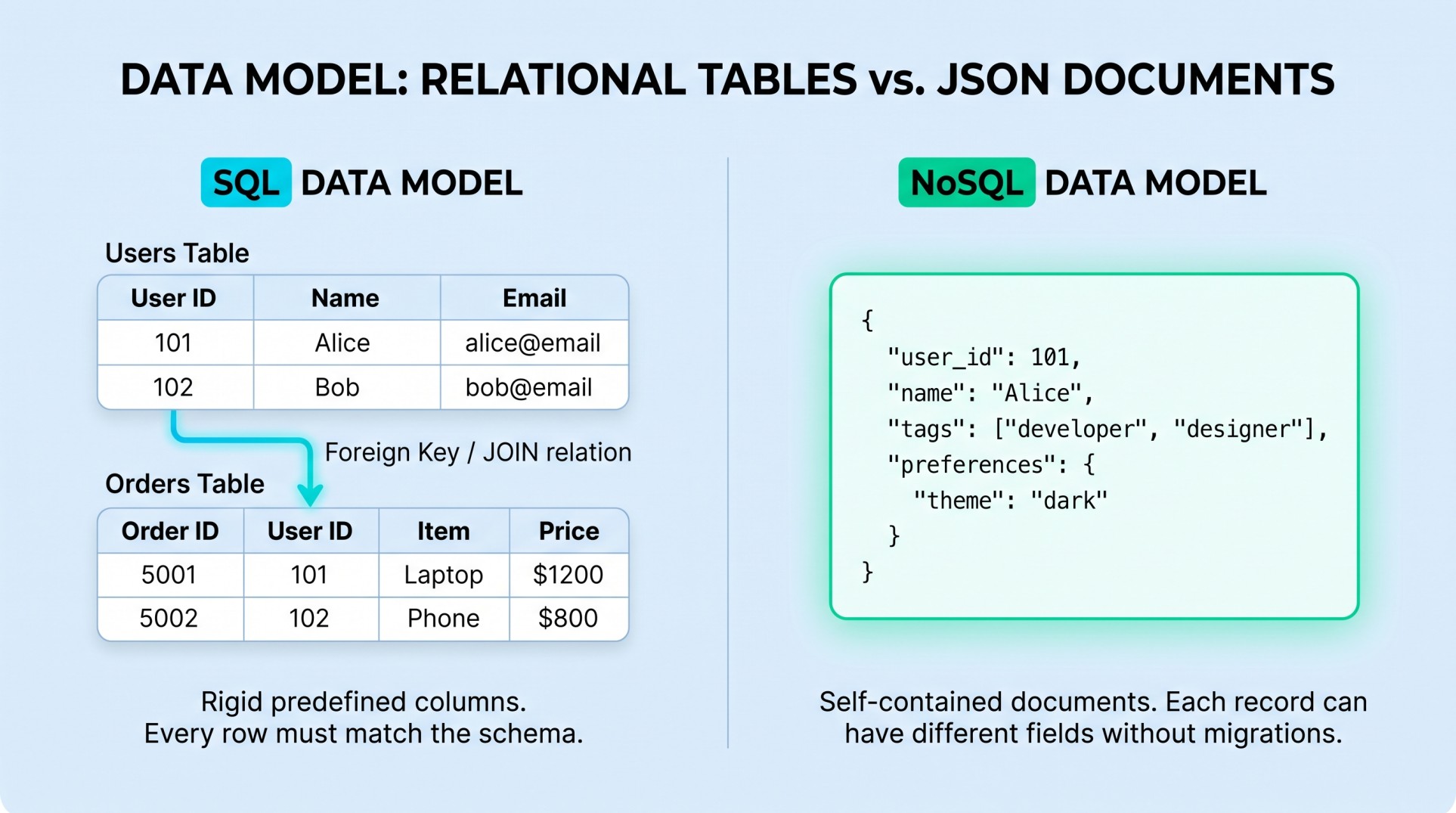
SQL databases have been the bedrock of enterprise software since the 1970s. They are built around relations—data is neatly split into structured tables that connect to one another through unique IDs (Keys).
Why Engineers Love SQL:
- Zero Surprises (Rigid Predefined Schema): Before you can write a single row of data, you must define the schema: column names, data types (Integer, String, Date), and constraints. If someone tries to save a letter inside a price column, the database blocks it instantly.
- ACID Transaction Guarantees: Imagine transferring $100 from Alice to Bob. SQL guarantees Atomicity—either both steps succeed (deduct $100 from Alice and credit $100 to Bob), or the entire transaction cancels completely. Money can never vanish into thin air!
- Powerful JOIN Queries: SQL makes it easy to write complex queries that cross-reference multiple tables in a single command (e.g., "Find all users in Dhaka who bought a book last Tuesday").
Best Use Cases for SQL:
- 💳 Banking & Financial Ledgers: Where transaction accuracy is non-negotiable.
- 🛍️ E-Commerce Order Management: Where orders, payments, and customer accounts must stay perfectly synchronized.
- 🏥 Healthcare & Patient Records: Where structured consistency and relational compliance are required.
2. NoSQL: The Flexible Scrapbook (Non-Relational Databases)
As the internet exploded with mobile apps, social media feeds, and IoT sensors in the late 2000s, engineers needed databases that could store rapidly changing data and scale effortlessly across hundreds of servers. Enter NoSQL.
Instead of forcing everything into rows and columns, NoSQL stores records as self-contained JSON Documents, key-value pairs, or wide-column families.
The 4 Major Types of NoSQL:
- Document Databases (e.g., MongoDB): Stores data in nested JSON documents. Each document can have completely different fields!
- Key-Value Stores (e.g., Redis, DynamoDB): Ultra-fast lookups where a unique key maps directly to a stored value.
- Wide-Column Stores (e.g., Apache Cassandra, ScyllaDB): Optimized for massive write throughput across billions of rows (e.g., time-series sensor data).
- Graph Databases (e.g., Neo4j): Stores data as interconnected nodes and relationships, perfect for social network friend graphs and recommendation engines.
Why Engineers Love NoSQL:
- Dynamic Schema Flexibility: Need to add a new
tiktok_handleordark_mode_preferencefield to a user profile? With NoSQL, you just start writing it. No slow database migrations or downtime required! - Built for Massive Speed & Writes: Because records are self-contained (no expensive multi-table JOIN operations), reading and writing individual documents is blazingly fast.
- Effortless Horizontal Sharding: NoSQL databases are designed from day one to distribute data automatically across dozens of machines.
Best Use Cases for NoSQL:
- 📱 Social Media Feeds & Comments: Where posts contain unpredictable mixtures of text, polls, images, and stickers.
- 📍 Real-Time Telemetry & GPS Tracking: Millions of vehicle sensor pings written every second.
- 🛒 Shopping Cart & User Sessions: High-speed temporary session storage.
- 🎮 Gaming Leaderboards & Profiles: Dynamic player inventory stats and live rankings.
3. How They Scale: Vertical vs. Horizontal Scaling
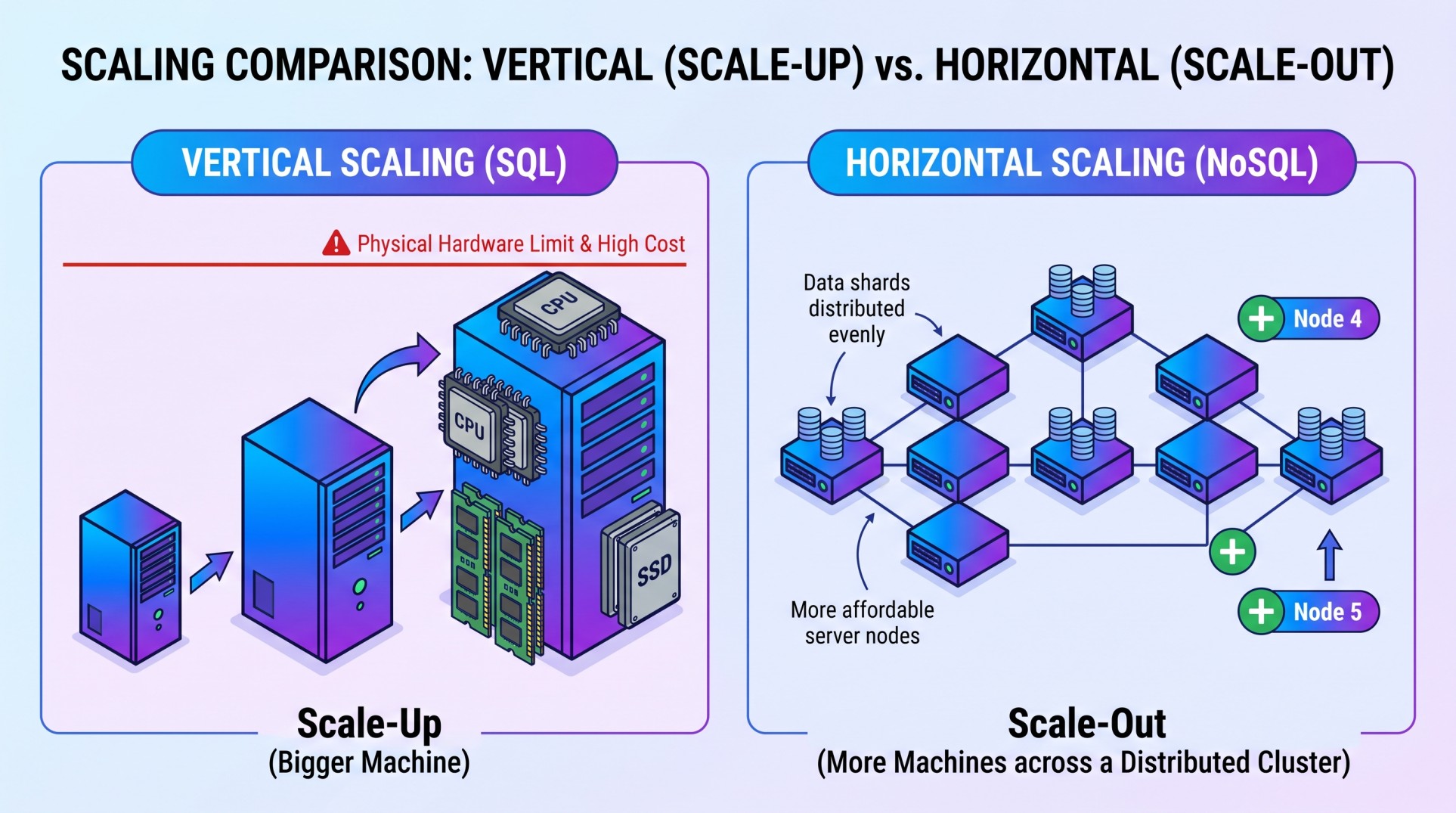
One of the most important architectural differences between SQL and NoSQL is how they handle massive traffic growth:
Vertical Scaling (Scale-Up) — Traditional SQL
- How it works: You take your single database server and upgrade its physical hardware—installing a faster 64-core processor, 512 GB of RAM, and multi-terabyte NVMe SSDs.
- The Catch: You eventually hit a hard physical hardware ceiling. The biggest machine money can buy has a limit, and enterprise monster servers become exponentially expensive.
Horizontal Scaling (Scale-Out) — Cloud-Native NoSQL
- How it works: Instead of buying one giant supercomputer, you connect a cluster of 10, 50, or 200 standard, affordable servers. The NoSQL database automatically splits your data into chunks (shards) and distributes them evenly across the cluster.
- The Superpower: Need to handle 5x more Black Friday traffic? Simply click a button to add 10 more server nodes to your cluster!
4. SQL vs. NoSQL: The Comprehensive Comparison
| Feature | 🗄️ SQL (Relational) | 🍃 NoSQL (Non-Relational) |
|---|---|---|
| Data Structure | Rigid tables with fixed rows & columns | Flexible JSON documents, Key-Value, or Graphs |
| Schema | Predefined, strict schema | Dynamic, schema-less flexibility |
| Transaction Model | Strict ACID (Immediate consistency) | BASE (Eventual consistency focus) |
| Scaling Model | Primarily Vertical (Bigger machine) | Built for Horizontal (Distributed clusters) |
| Complex Queries | Exceptional (Multi-table JOIN queries) | Optimized for single-key lookups & fast writes |
| Data Integrity | High (Foreign Keys, Constraints) | Application-managed validation |
| Popular Engines | PostgreSQL, MySQL, MariaDB, SQLite | MongoDB, Apache Cassandra, Redis, DynamoDB |
5. Real-World Architecture: How Ride-Sharing Apps Use Both (Polyglot Persistence) 🚗
Senior engineers never treat SQL and NoSQL as enemies. In modern distributed systems, production platforms practice Polyglot Persistence—using both database engines side-by-side!
Let's look at how a ride-sharing platform like Uber or Pathao splits its workloads:
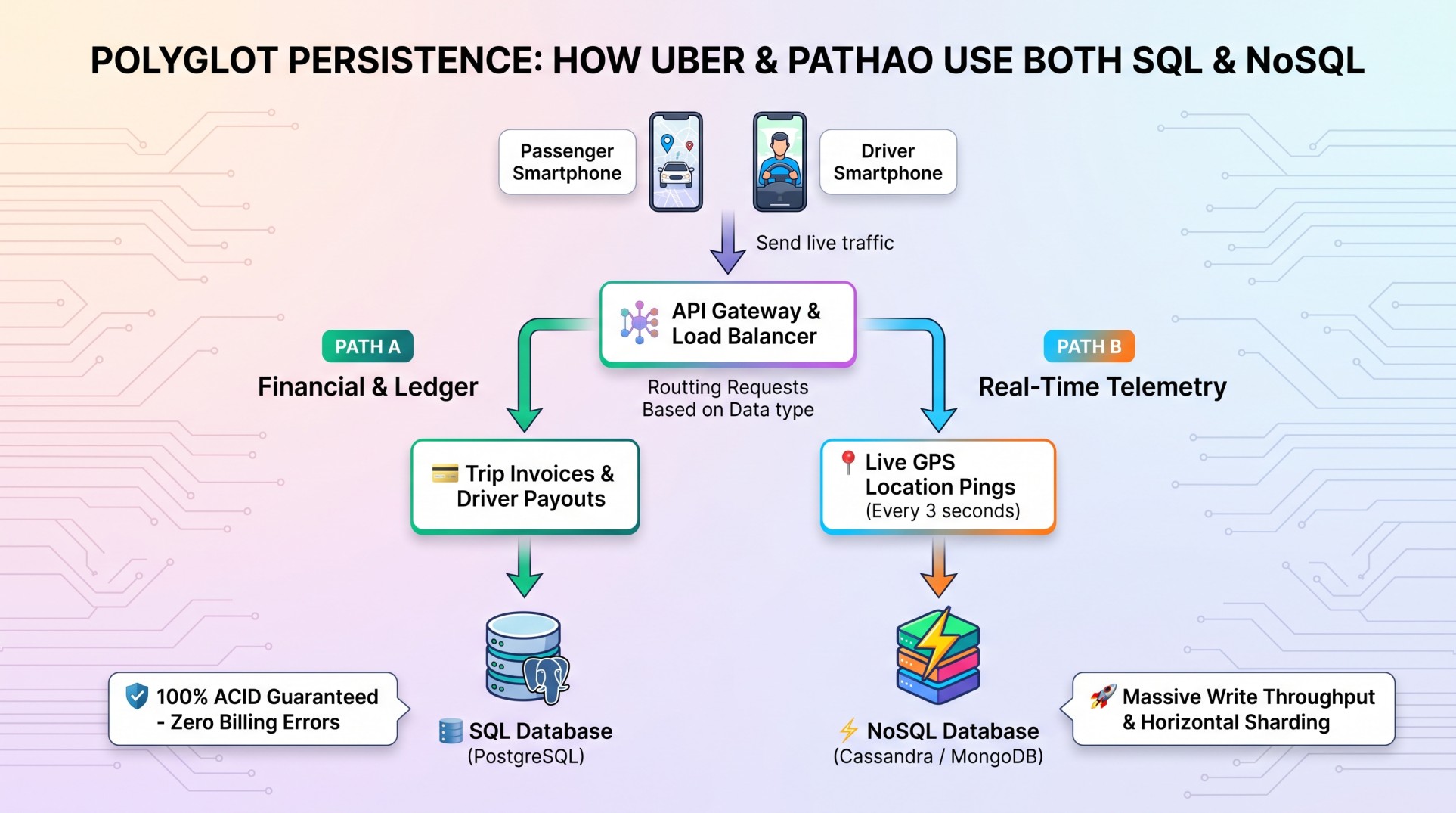
1. The Financial Ledger $\rightarrow$ Powered by SQL (PostgreSQL)
- When a ride finishes, the platform calculates the trip fare, adds taxes, applies discount promo codes, charges the passenger's credit card, and credits the driver's payout account.
- Because real money is involved, this requires strict ACID transactions. You cannot have a scenario where the passenger is charged but the driver is not credited. PostgreSQL ensures 100% mathematical integrity.
2. Live Driver GPS Tracking $\rightarrow$ Powered by NoSQL (Cassandra / Redis)
- While on a trip, 100,000 active drivers broadcast their precise latitude and longitude GPS coordinates every 3 seconds.
- Storing hundreds of thousands of live coordinates per second would completely lock up a relational SQL database.
- A NoSQL wide-column database (like Apache Cassandra) or in-memory store (Redis) absorbs this massive continuous firehose of writes effortlessly!
🍕 Explain It Like You're 5
If you are keeping track of your bank piggy bank savings (SQL), you write every single penny neatly into a strict ledger notebook so you never lose a cent.
If you are collecting fun stickers, doodles, and superhero cards (NoSQL), you paste them freely into a fun scrapbook without worrying about straight lines or margins!
🎯 The System Design Interview Summary
In a senior system design interview, never give a generic answer like "NoSQL is modern so it is always better" or "SQL is outdated".
Use this decision checklist to impress your interviewer:
Choose SQL (PostgreSQL / MySQL) when:
- Your data has clear relational connections (Users have Orders, Orders have Line Items).
- You require 100% strict ACID consistency (Banking, Invoicing, Inventory).
- The total dataset fits within a single vertically-scaled database server with read-replicas.
Choose NoSQL (MongoDB / Cassandra / DynamoDB) when:
- You have massive data volume growing into tens of terabytes with continuous high-velocity writes.
- Your data schema evolves rapidly or varies between records.
- Your system requires native horizontal scaling and multi-region distributed sharding.