TCP and UDP are the two main ways data moves across the internet. When designing a system, choosing between them determines whether your app prioritizes absolute reliability or blazing speed.
Before deciding which protocol fits your architecture, you need to understand how both work under the hood. Here is a simple, visual breakdown using everyday real-life examples. At the end, we'll guess which real-world platforms (like Netflix, Uber, or Foodpanda) use which!
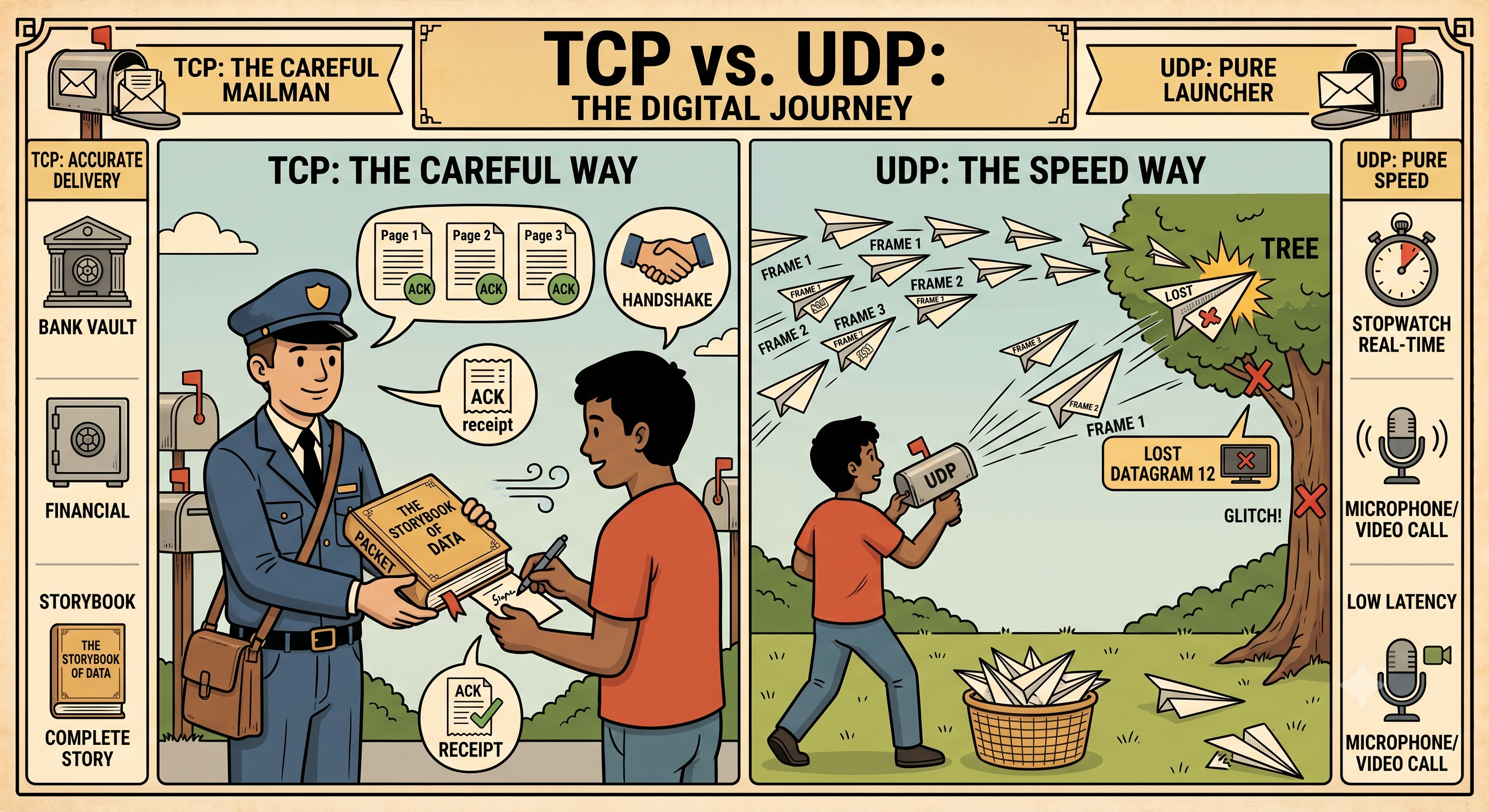
Keywords
- TCP: Transmission Control Protocol
- UDP: User Datagram Protocol
- Handshake: Connection Setup
- Packets: Small Pieces Of Data
Character Mapping
- TCP: A careful mailman who delivers every single letter in order, and makes the receiver sign a receipt.
- UDP: A paper plane launcher who throws 100 paper planes as fast as possible without worrying if a few crash.
1. The TCP Way: The Careful Mailman
Imagine you want to send a 3-page storybook to your friend who lives across town.
Step 1: The Secret Handshake (Connection Setup)
Before sending any actual data, TCP performs a 3-Way Handshake. The Mailman visits your friend and asks: "Are you ready to receive a letter?" Your friend answers "Yes, I am!", and the Mailman replies "Great, sending it now!"
Step 2: Checking Every Page (Reliability & Order)
The Mailman delivers Page 1. Your friend sends back an ACK (receipt) saying: "Received Page 1!" Next, the Mailman tries to deliver Page 2, but a strong wind blows it away! The Mailman notices the missing ACK, goes back, and resends Page 2 until your friend confirms receipt.
Step 3: In-Order Assembly
If Page 3 arrives before Page 2, your friend waits until Page 2 is re-delivered so the story can be read in the exact order it was written.
What is it for?
Use TCP when data accuracy and order are mandatory, and losing even a single byte breaks the entire system.
2. The UDP Way: The Paper Plane Launcher
Now imagine you are playing a fast-paced game of dodgeball, or streaming a live event with your friend.
Step 1: Fire Away! (No Handshake Required)
There is no pre-connection check. You fold 100 paper planes carrying real-time video frames and launch them toward your friend's yard as fast as you can.
Step 2: Speed Over Perfection
Plane #12 gets caught in a tree and crashes. Do you pause the game, run outside, fold a new plane, and re-throw Plane #12? No! By the time that plane arrives, the game has already moved forward 5 seconds. Your friend doesn't care about one missing frame. They just want the stream to keep playing without freezing.
What is it for?
Use UDP when real-time speed and low latency matter most, and losing a minor packet is preferable to halting the entire application.
3. Which Platforms Use Which?
Now that you know the rules, let's look at real-world systems. Can you guess which protocol powers these services?
Scenario A: Uber / Pathao (Live GPS Driver Tracking)
How it works:
Your phone receives continuous GPS coordinates (latitude, longitude) from your ride-share driver every 1–2 seconds.
Which protocol?
UDP (for the location stream). If a location ping drops at second 04, the system doesn't need to re-request it. It simply displays the fresh update at second 05.
Scenario B: Foodpanda / Uber (Order Payment & Receipt)
How it works:
You process a payment for your food order.
Which protocol?
TCP. A dropped or duplicate packet here could mean double-charging your credit card or dropping an order status update!
Scenario C: Netflix / YouTube (Video Streaming)
How it works:
Video content delivery relies on smooth buffering and full image clarity.
Which protocol?
TCP (via HTTP/HTTPS). Modern video platforms pre-buffer video chunks using TCP to ensure high video quality and zero corrupted video frames.
Scenario D: WhatsApp / Zoom (Real-Time Voice & Video Calls)
How it works:
You are on a live voice call with a colleague.
Which protocol?
UDP (often managed via WebRTC). If a packet drops, you hear a tiny 10-millisecond audio glitch, but the call continues in real-time without buffering delay.